
Workshop
Layout without a calculator: square, spacing and curves
Square from a tape, diagonals without reading numbers, splitting a board without dividing, arcs from a batten.
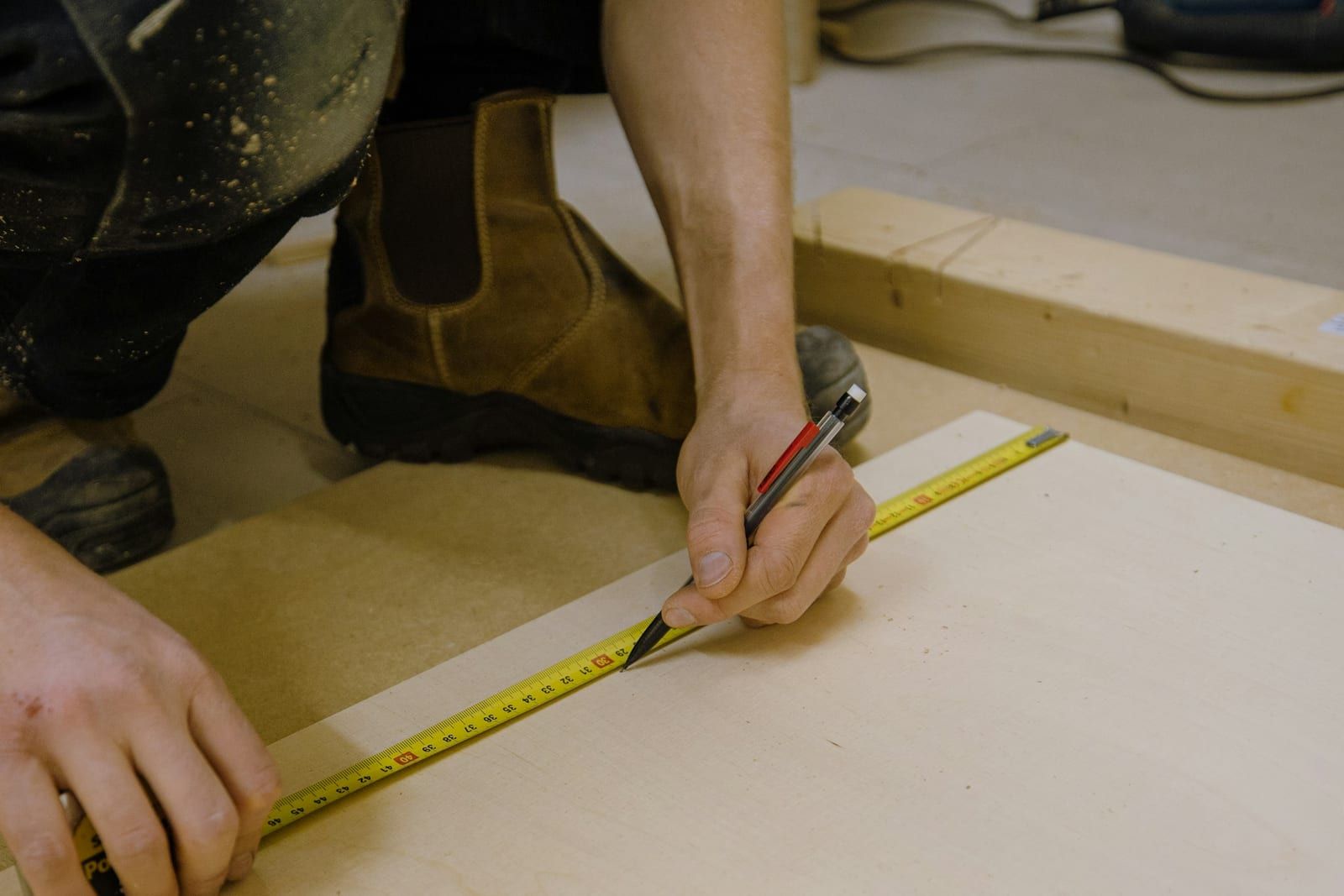
The carcass passed the square on every corner, and the back still won't go in. Usually a number is to blame: a tape that lied by a millimetre, or 56.666 rounded up to 57. Most layout can be done without a calculator, and even without reading numbers. This post covers square corners, spacing and curves. A tape, a square, a pencil, a pair of compasses, a strip of wood and a strip of paper. The formulas are in boxes, for anyone who wants to know why it works.
Square: the bigger the triangle, the better
Measure 300 mm from the corner along one side, 400 mm along the other, and check for 500 between the marks. If it's 500, the corner is square. The trouble is that it's a short triangle and forgives too much. On a frame for fitted units or a big worktop, go straight to 900, 1200 and 1500. Same trick, and a millimetre off on the diagonal means a third as much.
Two small things about the measuring. The hook on a tape is loose on purpose, but after a few drops it's often bent, so for a careful reading start at the 100 mark and take 100 off. And mark with a small "V" whose point sits on the line, not a dash. A pencil line has width of its own.

The maths
a² + b² = c²
300² + 400² = 500². A 1 mm error on the diagonal puts a 300-400-500 corner about 4.2 mm out per metre, and a 900-1200-1500 corner about 1.4 mm.
Measure the diagonals with sticks, not a tape
During assembly the square goes on every corner. Once the clamps are on, you check the whole thing, because a carcass can rack as a unit even when each corner looks fine. That's what the diagonals are for. A tape inside a carcass is awkward and leaves you comparing two numbers. Two sticks are better. Overlap them, slide them out until the ends sit in opposite corners, and pencil across the overlap. Move them to the other diagonal. If the mark lines up, the carcass is square. If not, clamp across the longer diagonal, a little at a time, until the sticks fit both ways.

While we're on tapes: two different ones can disagree by more than a millimetre and both be in spec. Use one for the whole job.
The maths
diagonald = √(a² + b²)
class II tape±(0.3 + 0.2 · L) mm
A 600 × 720 mm carcass has a 937.2 mm diagonal. L in the second formula is the length in metres, so over 3 m a tape may be out by ±0.9 mm.
Dividing without dividing
The board is 170 mm wide and you need three equal strips. Don't divide. Lay the tape across the board at a slant, with zero on one edge and 180 on the other. 180 divides by three, so you mark 60 and 120. Ten seconds. The middle of a board works the same way: on a 173 mm board, set the tape from 0 to 200 and mark 100.

A strip of paper does the same without a tape. Hold it against the edge, mark the length, and fold it so the marks meet. The crease is the middle. Fold again for quarters. Thirds take a moment's practice: roll the strip into three layers like a letter for an envelope and shuffle them until the edges line up. Ninths, for drawer fronts in a 2 : 3 : 4 ratio, are quicker with the slanted tape above than by folding.

For shelves, don't measure the gaps. Cut a piece of offcut to one gap and stand it between each shelf or mark in turn. Every gap comes out the same, because it's the same block. If you do mark with a tape, measure every position from one edge. Stepping the same distance five times in a row adds up the errors.
The maths
g = (H − n · t) / (n + 1)
The gap g for n shelves of thickness t in a height H. A 720 mm cabinet with five 18 mm shelves: 105 mm.
Dividers split a length without numbers too. Set them by eye to a fifth of it and step off five times. If the last step lands short or long, change the setting by about a fifth of the difference and go again. Two tries is usually enough.
Arcs, polygons and circles
A curved table apron or a cut-out in a plinth doesn't need a centre point. Drive three nails: one at each end of the arc and one at the top. Bend a thin, straight batten between them and draw along it. On a shallow arc you won't see the difference from a true circle.
The maths
R = c² / (8h) + h / 2
The radius of an arc with chord c and rise h. For 800 and 60 mm, about 1363 mm.
An octagon from a square post: draw both diagonals on the end, set the compasses to half a diagonal, and swing an arc from each corner onto the sides. The eight points on the sides are the corners of the octagon.

A circle you divide with compasses by halving. Draw a diameter. Open the compasses wider than the radius and, from both ends of the diameter, swing arcs above and below the circle. A line through the two crossings gives you quarters. Halve each quarter the same way. Six parts is easiest of all, because compasses set to the radius go round exactly six times. Five parts you step off by trial, as with a straight line, always from one point in both directions.

The maths
k = 2R · sin(180° / n)
The compass setting k for n parts of a circle of radius R. A 600 mm round top on five legs: 352.7 mm.
When you don't know where the centre of a round top is, set the corner of a square on the edge and join the two points where the blades cross the rim. That's a diameter. A second one crosses it at the centre.
An oval from string: draw both axes. Set the compasses to half the long axis and, from the end of the short axis, mark two points on the long one. Drive nails there, drop a loop of string over them, pull it tight with a pencil at the end of the short axis and go round. The string mustn't stretch. R. G. Hatfield said linen, not an elastic line, back in 1844.

The maths
focic = √(a² − b²)
loops = 2a + 2c
a and b are the half axes. An 800 × 480 mm top: foci 320 mm from the centre, a 1440 mm loop.
One tape for the whole job, a stick instead of numbers wherever you can, and a mark shaped like a "V". The rest is cutting.
Sources
- R. G. Hatfield, The American House-Carpenter (opens in a new tab), 1844 (1871 edition): the 6-8-10 rule, dividing a line, finding a centre, the string ellipse
- P. Dulak, Shop-Made Pinch Rods (opens in a new tab), Popular Woodworking, 2021
- J. Eakes, Finding the centre of a board (opens in a new tab), 1999
- Tape accuracy classes, EU measuring instruments directive, Annex MI-008: tolerance table (opens in a new tab)