
Jigs
A wedge clamp: holding a board for planing without a vice
A stop, two battens and a loose wedge hold a board flat on the bench for planing. Plus similar ways.
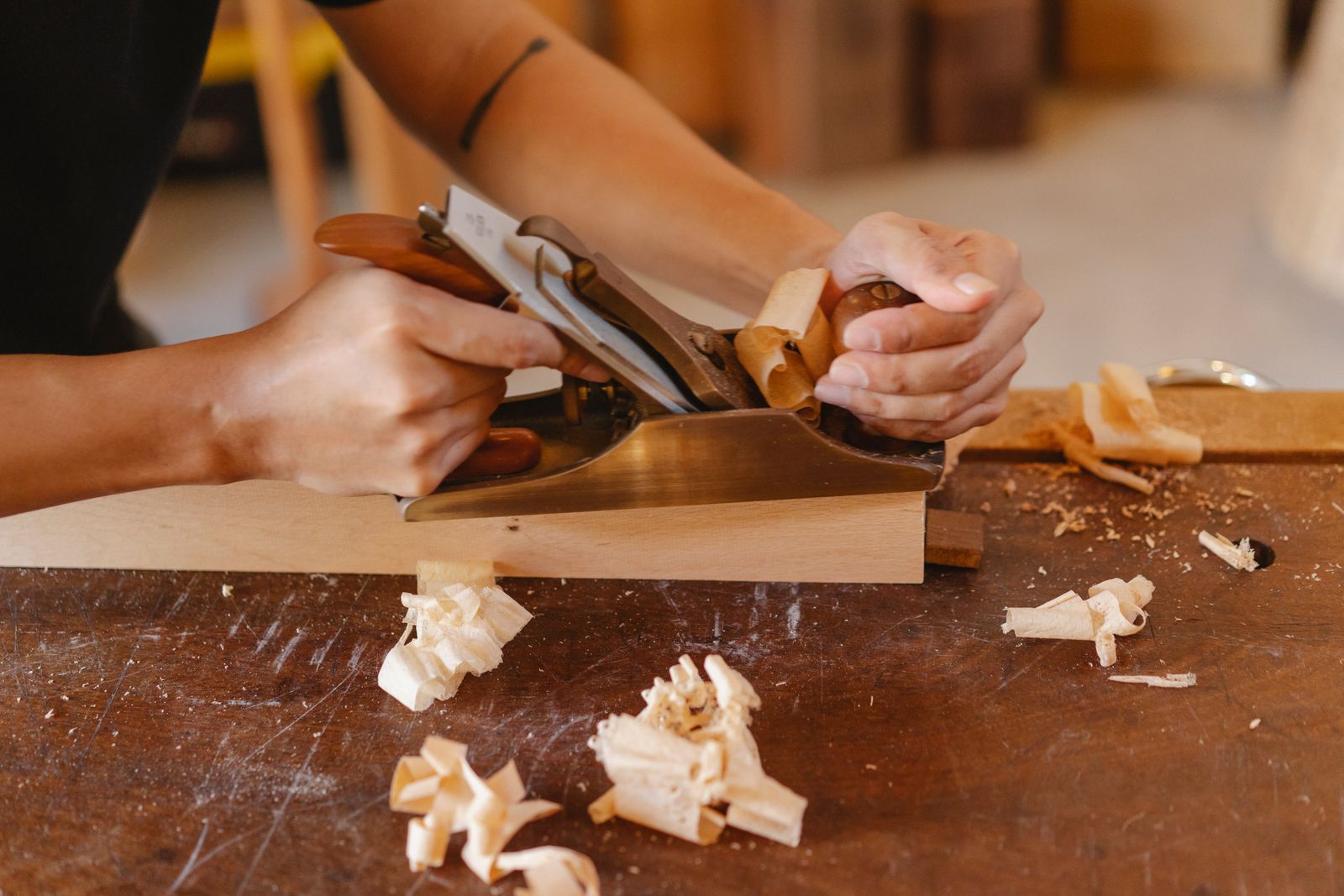
A long, thin board held in the vice flexes under the plane. It's better to lay it flat on the bench. Woodworkers have long had tried and tested ways to do that, and they still use them. One of them is a wedge clamp: the end of the board rests against a stop and a loose wedge presses it in from the side. You need three battens, a wedge and a few clamps.
How it's built
There are three battens on the bench. A short one across the end is the stop, and the end of the board bears on it. A straight batten along one side of the board gives it something to lean on. The third batten, on the other side, lies at a slight angle: closer to the board at the stop, further away at the far end. The wedge goes in between it and the board.

Cut the wedge to the same angle as the angled batten. One face then sits against the batten along its length, and the other is parallel to the edge of the board and presses it evenly. The shallower the wedge, the harder it grips and the less it tends to pop out.
Clamp the battens and the stop to the bench with ordinary clamps, near the ends, where they stay out of the plane's way.
Everything lower than the board
The stop and both battens must be lower than the board you're planing. If they stand proud of it, the plane iron catches them at the end of a stroke. For thin boards, use thinner battens.

Using it
Lay the board against the straight batten and slide its end up to the stop. Push the wedge in from the wide end of the channel and tap it lightly towards the stop. Always plane towards the stop, so each stroke pushes the board harder against it. To release the board, knock the wedge back from its thin end.

The clamp holds straight boards well. A short piece has too little edge for the wedge to bear on, and a bowed board flexes under the plane unless you pack it underneath.
Similar ways
The most basic is a stop on its own: a batten clamped across the bench. Rest the end of the board against it and plane towards it. That's enough for planing a flat face, but nothing holds the sides of the board, so a stroke at a slight angle pushes it sideways. That is exactly what the wedge clamp fixes.

A little more involved is a board with a square V-notch in its end, known as a doe's foot, clamped to the bench. Rest one end of a narrow piece against the stop and slip the other end into the notch. Leave narrow flats at the tips of the notch, so they don't dent the piece.

The same idea can be built into the bench. Old Norwegian school benches had a planing stop with teeth: the end of the board was pushed onto the teeth, the board rested against a board along the front of the bench, and a wedge went in when it would not stand securely.
Sources
- G. Larsson, Elementary Sloyd and Whittling (opens in a new tab), 1906, p. 13: a single stop for planing a flat face
- C. Schwarz, A Devilishly Clever Foot (opens in a new tab), Popular Woodworking, 2026: the doe's foot, flats at the tips of the notch
- C. Schwarz, The Norwegian Wedgebench, Lost Art Press, 2021 (a translation of H. K. Kjennerud and K. Løvdal, Sløidlære for skole og hjem): a toothed planing stop and a wedge in a school bench